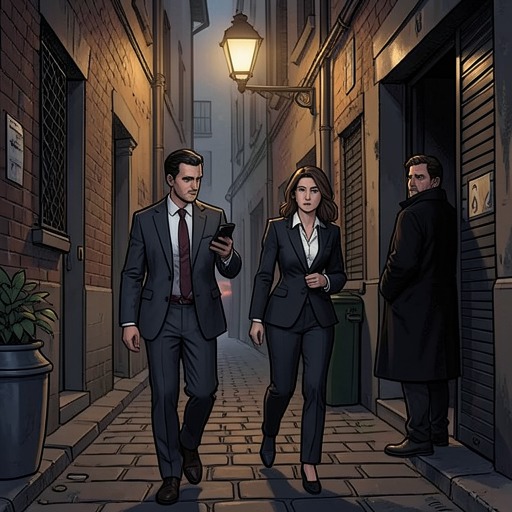
Porter Road
The PeripheralPorter Road is the route connecting Flynne Fisher’s home with town, and its familiar stretches become part of the story’s security landscape: a drone shadows Flynne there, Burton and Leon wait for her beneath a streetlight, and a multiple homicide brings investigators to the road. Its role shifts from everyday passage to a place where surveillance and lethal danger are made visible.
Route and Everyday Use
Flynne rides Porter Road home from Jimmy’s after a difficult evening. She is pedaling hard both to charge the bicycle’s hub battery and to tire herself out enough to sleep. The road’s lights and curves structure her journey: on a level stretch, she notices a small drone matching her speed; farther along, it appears again as she approaches the curving downhill section.
Porter Road also links Flynne’s movements to those of her family and acquaintances. Burton and Leon are waiting beside a rented car under a streetlight, having returned from Davisville. Burton invites Flynne into the car, while Leon takes her bicycle. The exchange makes the road a practical meeting point, where family members can intercept one another on the way home.
Surveillance and the Aquamarine Marker
The drone following Flynne is about the size of a robin and has a single rotor. On its side she recognizes a one-inch square of aquamarine duct tape, a distinctive color Leon had brought home from a swap meet. He and Burton had used the tape as a team badge on their toys during drone games, so its appearance suggests a familiar connection even as Flynne doubts that this is play.
Flynne infers that the drone is seeing her home from Jimmy’s, and that Burton and Leon must have returned from Davisville. Under the next streetlight, Leon reaches up and plucks it out of the air as Flynne brakes beside them. The road thus becomes not merely a place being watched but a place where surveillance is physically interrupted. The tape’s private, homemade association contrasts with the drone’s apparent role in monitoring Flynne.
The Homicide Investigation
Later, Deputy Tommy Constantine comes to the Fisher property at night and asks Burton to look at four people found dead on Porter Road. Flynne hears the exchange from her bedroom and joins them outside. Tommy describes the deaths as a multiple homicide carried out in an assassination style, midway between the house and town. The victims had come a considerable distance: they had stolen a car outside Memphis.
At the roadside, Jeffers explains what investigators can establish. The vehicle’s front wheel is in a ditch, suggesting it left the road at speed; all four men were shot in the head from outside the vehicle. None had identification on them, and investigators suspect they had left it elsewhere for later collection. These details point to a planned attack but do not establish exactly how it happened.
Competing Accounts and Significance
Jeffers offers a possible reconstruction rather than a settled conclusion: someone may have blocked the road, shot the driver first, and then approached the other occupants before they could respond. He also raises the possibility that the attack involved someone who drove a trike. The investigation therefore connects the deaths to the road’s local traffic and to the possibility of an ambush, while leaving the precise sequence uncertain.
The drone encounter and the homicide give Porter Road two related but distinct functions. In one, the threat is an unseen observer whose machine can be caught and identified by a tiny scrap of colored tape; in the other, investigators reconstruct violence from a vehicle, missing identification, and the victims’ position. Together they make the road a threshold between town and home where ordinary travel intersects with surveillance and danger, without making the drone episode and the killings demonstrably part of one incident.